
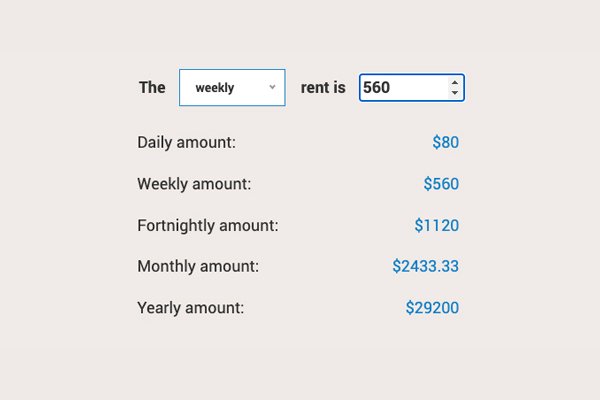
When hunting for a new home, many tenants accidentally fall into a costly financial trap that completely disrupts their long-term financial planning. They scroll through properties advertised at a weekly rate and try to calculate their monthly obligations by multiplying that number by a standard factor of four. This quick, flawed mental math leads to a shocking surprise when the first official leasing contract arrives in their inbox. Because calendar months are longer than exactly four weeks, your actual ongoing expenses will be significantly higher than a basic four-week estimation.
Relying on an automated weekly to monthly rent calculator saves you from unexpected financial strain, ensuring you know exactly how much hard-earned money leaves your bank account every single month. By visualizing your true financial commitments ahead of time, you eliminate the stress of moving day and protect your emergency savings. This simple step bridges the gap between how landlords list properties and how you actually manage your household income. It transforms confusing industry pricing structures into clear data points you can easily use to build a secure, balanced monthly budget.
The Real Math: How a Precise Weekly to Monthly Rent Calculator Processes Your Numbers
To understand why simple multiplication fails so spectacularly, we have to examine the subtle mechanics of our Gregorian calendar. A standard calendar year contains 52 weeks rather than 48, which leaves a surplus of roughly four weeks unaccounted for if you just multiply a weekly figure by four. A professional weekly to monthly rent calculator solves this structural issue by applying a legally compliant, mathematically precise formula to your entered values. This system automatically breaks down the calendar year into exact days, ensuring no hidden costs escape your notice during the application process.
First, the online conversion system divides your advertised weekly rate by 7 to determine your exact daily housing cost. Next, it multiplies that precise daily figure by 365 days—or 366 during a leap year—to find the true annual total of the lease. Finally, dividing that large annual sum by 12 yields your correct Per Calendar Month (PCM) total, giving you a crystal-clear picture of your true housing costs. For those doing a quick check on their smartphones while touring a property, multiplying the weekly rent by a factor of 4.333 serves as a highly accurate manual shortcut.
The Big Reasons Landlords and Tenants Absolutely Need Exact Estimation Tools
Accurate figures keep both sides of a modern rental agreement fully protected, satisfied, and aligned with financial expectations. Landlords must utilize precise financial figures to draft legally binding contracts that clearly outline monthly obligations without causing future payment disputes or administrative delays. For tenants, using a reliable weekly to monthly rent calculator guarantees that your initial upfront payments, prorated rent schedules, and ongoing security deposits match your expectations perfectly. Having these numbers prepared allows you to negotiate tenancy terms with complete confidence and legal clarity.
Furthermore, moving into a new property involves significant secondary expenses, such as utility connection fees, council taxes, and professional moving truck services. Knowing your exact monthly commitment allows you to plan your liquid savings effectively, ensuring you do not drain your cash reserves during the transition phase. By eliminating simple guesswork from your mathematical equations, you can sign your next tenancy agreement with complete confidence and total peace of mind. Accurate budgeting ensures you enjoy your new living space rather than worrying about upcoming financial shortfalls.
Navigating Diverse Rental Metrics: Affordability Standards and Commercial Spaces

Securing a premium rental property in today’s competitive market requires meeting strict background checks and income thresholds. Most modern letting agencies utilize standard affordability benchmarks, requiring a tenant’s verified gross annual income to equal at least 30 times the calculated monthly rent. Using a digital weekly to monthly rent calculator helps you verify if you qualify for a specific listing before spending money on non-refundable application fees. This proactive step saves valuable time and helps focus your property search on realistic options.
The math becomes even more critical when looking at commercial storefronts, warehouse spaces, or industrial properties for expanding businesses. Business leases often calculate base operational costs using annual square footage metrics rather than simple weekly residential rates. Seamlessly converting these values into predictable monthly operational expenses ensures a small business can maintain steady cash flow and remain highly profitable throughout the fiscal year. Proper calculation prevents overhead costs from eclipsing monthly revenue targets, keeping business owners in complete control of their commercial balance sheets.
The Modern Vehicle Trend: Why People Are Now Renting Cars on a Monthly Basis
The modern rental ecosystem has evolved far beyond traditional brick-and-mortar apartments to include flexible transport solutions. An exploding number of digital nomads, corporate professionals, and savvy consumers are utilizing a specialized weekly to monthly rent calculator to manage long-term vehicle commitments. Instead of getting locked into multi-year auto financing plans or expensive loans, flexible monthly car subscriptions have quickly become the preferred method for modern urban transportation. This shift reflects a broader global preference for subscription-based utility over permanent asset ownership.
Choosing a long-term vehicle rental offers massive cost advantages over standard daily rates, which often feature steep premiums. Major metropolitan hubs, particularly highly competitive tourist and business markets like Dubai and Abu Dhabi, offer massive discounts for drivers who book vehicles in 30-day blocks. Calculating these financial shifts accurately allows extended travelers to secure reliable transportation without overpaying for daily rental renewals. Embracing this modern methodology helps consumers align their transportation expenses directly with their short-term geographical needs and professional assignments.
The Bottom Line: Take Total Control of Your Rolling Monthly Budget
Mastering your personal cash flow requires absolute mathematical precision rather than loose, casual estimates that leave room for error. By using a robust, instant weekly to monthly rent calculator, you successfully eliminate the psychological and financial errors that threaten your long-term savings goals. Whether you are currently budgeting for a luxury high-rise apartment, a commercial storefront, or a long-term vehicle subscription, exact figures are your absolute best financial ally. Protecting your wealth always begins with knowing your true baseline expenses.
Do not let hidden calendar variations disrupt your household budget, business accounts, or personal peace of mind. Bookmark this free digital conversion tool today to run fast, reliable calculations whenever you evaluate new property or vehicle listings. Empowering your daily financial decisions with instant clarity allows you to avoid costly contractual surprises and keep your hard-earned money working efficiently for you. True financial freedom is built on accurate information, and this tool provides the exact clarity you need to succeed.
Frequently Asked Questions (FAQs)
How do you accurately convert weekly rent to monthly rent?
The most accurate method is to divide the weekly rent by 7 to find the daily rate, multiply that daily rate by 365 to calculate the annual cost, and then divide the annual total by 12. Alternatively, you can multiply the weekly rent by the standard calendar multiplier of 4.333 for a fast and reliable estimation. This standard multiplier accounts for the uneven distribution of days across different months, ensuring your final calculated total reflects true calendar realities rather than generalized assumptions.
Why can’t I just multiply my weekly rent by 4 to get the monthly total?
Multiplying by four assumes that every month is exactly 28 days long. Since February is the only month that fits this description, using a factor of four ignores nearly one full month of days over the course of a year. This error results in underestimating your true monthly costs by roughly 8.3%, leading to severe budgeting shortfalls. Over a twelve-month lease, this mathematical blind spot can accumulate to a full month of unpaid rent, creating unexpected debt and unnecessary friction with your landlord.
What does the term PCM mean on rental property listings?
PCM stands for “Per Calendar Month.” This represents the fixed amount of money a tenant must pay their landlord each month. This amount remains exactly the same regardless of whether the specific month has 28, 30, or 31 days, providing consistent budgeting for the duration of the lease. Understanding this term helps you compare different properties accurately, as it establishes a uniform baseline cost that applies across the entire calendar year, regardless of seasonal shifts or variations in month length.
What is the standard 30 times monthly rent rule for tenants?
The 30 times rule is a strict affordability standard used by landlords and letting agencies to verify a tenant’s income. It dictates that a renter’s gross annual income must be at least 30 times the monthly rent amount to ensure they can comfortably afford the property without defaulting on payments. Passing this threshold demonstrates to the leasing agent that you possess sufficient financial cushioning to cover housing costs while maintaining a reasonable standard of living and meeting other essential financial obligations.
Is it cheaper to secure a vehicle for a monthly rent rather than daily?
Yes, securing a vehicle on a monthly contract is significantly more cost-effective per day than booking daily rentals. Car rental agencies offer massive discounts for continuous 30-day agreements because it guarantees vehicle utilization, eliminates administrative turnaround times, and reduces vacant inventory costs. For consumers, this translates to a lower per-day rate, giving you access to reliable transportation without the premium fees associated with short-term, daily rentals or the rigid commitments of traditional vehicle ownership.
You may also read: How to Get a Zego Car Insurance Quote









Leave A Comment